the stability of 259VHP

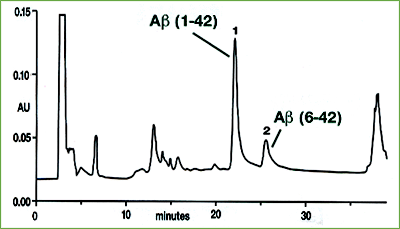
Purification of Recombinant ¥â-Amyloid Peptide (1-42) from Fusion Cleavage
Purification of ¥â-amyloid protein is challenging due to its tendency to aggregate and inherent low solubility


Conditions
Column: Vydac 259VHP54, (polymer reversed phase, 5§­, 4.6§® i.d. x250§®). 1mL/min. 60¡É. A=5% ANC 5mM NH4OAc, pH 7.0. B=10% IPA, 80% ACN, 5mM NH4OAc, pH 7.0, 0-24% B in 5 min., 24-27% B in 25 min., then 27-100% B in 5 min. Courtesy of N.K. Menon, A.E. Przybyta, E.B. Neuhaus, and R.A.Makula, Fermentation Research Facility, Department of Biochemistry, University of Georgia (See Vydac Application Note #9901. Available on Vydac's web site at http://www.vydac.com)


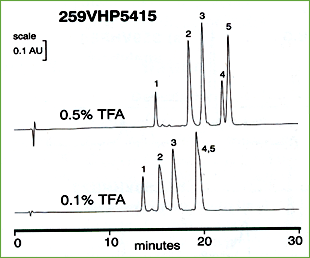
Peptide mixture
Increasing TFA concentration alters selectivity in a fashion similar to that seen with silica-based reverse-phase columns. Higher TFA concentrations will not reduce the life of 259VHP columns because they are resistant to these very acidic conditions.

Conditions
Column: Vydac 259VHP5415 (polymer reversed-phase, 5§­, 4.6§® i.d. x 150§®). 1.0 mL/min., absorbance at 220 nm, room temperature, gradient over 40 min. from 10% to 50% ACN in water with indicated concentration of TFA(w/v).
Peaks:1 oxytocin; 2. bradykinin; 3. angiotensin II; 4. neurotensin; 5. angiotensin I.


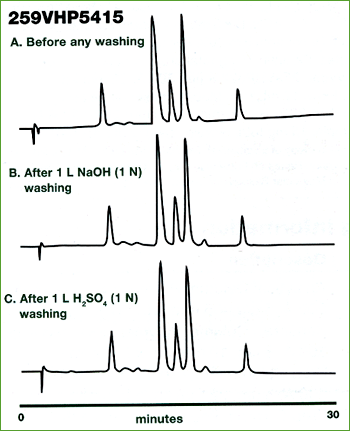
Chemical Stability Test
No noticeable change in peptide separation after a 400 column-volume wash with strong base or strong acid.